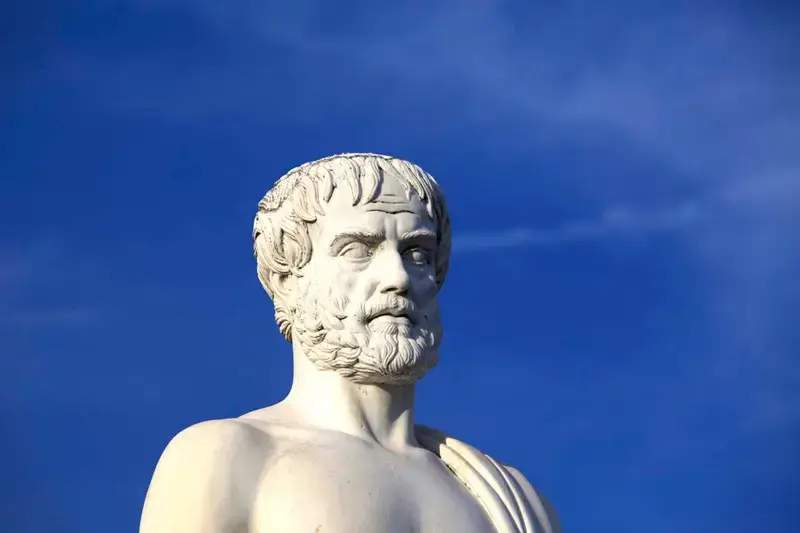
Antiquity's greatest thinker is a Halkidiki native: Aristotle was born in 384 BC at Stagira, on the peninsula's northeastern coast. Yet most visitors to Halkidiki never learn they can walk his city, stand on its walls and "play" with the natural phenomena he described — all within a day.
Who he was (in 60 seconds)
Son of Nicomachus, physician to the Macedonian king, Aristotle left at 17 for Plato's Academy in Athens, staying twenty years. Philip II summoned him to educate his son — Alexander. He later founded his own school in Athens, the Lyceum, laying the foundations of what we now call logic, biology, ethics and political science. He died in 322 BC — but his homeland honoured him: tradition holds the Stagirites carried his bones back to the city.
Ancient Stagira (Olympiada)
His birthplace occupies the Liotopi peninsula beside today's Olympiada: walls, foundations of houses and sanctuaries, and a seaside path that turns the visit into an Aegean-view walk. Free entry, ideally early morning or towards sunset — followed by a swim at Olympiada's beach and mussels at its tavernas.
The Aristotle Grove (Stagira village)
Forty minutes inland, at the mountain village of Stagira which inherited the name, operates Halkidiki's cleverest "monument": an open-air park of interactive instruments — sundials, lenses, pendulums, sound discs — bringing to life phenomena from his Physics. With the philosopher's great statue and panoramic views to the Ierissos gulf, it is the best stealth physics lesson a child can get on holiday. Free, always open.
The Aristotle route in one day
- Morning: The Aristotle Grove at Stagira — cool air and a clear view.
- Noon: Down to Olympiada (~15 minutes), ancient Stagira and a swim.
- Afternoon: Olympiada mussels by the water — returning via Arnaia for coffee in the listed old town.
Practical notes for international visitors
For culturally-minded travellers Stagira is a quiet highlight: the birthplace of the philosopher whose terms still frame school curricula worldwide — and almost tourist-free. The walking route through the excavation is open and free, 1-2 hours. With kids, reverse it: the Aristotle Grove in the mountain village first, with its interactive physics instruments, then swimming and mussels in Olympiada. On-site signage is Greek/English.
Frequently asked questions
Where exactly was Aristotle born?
At ancient Stagira — the peninsula beside today's Olympiada. The mountain village "Stagira" took the name honorifically and hosts the Grove with the instruments.
Is the archaeological site worth it if I'm not "into ruins"?
Yes — because it is as much a walk as a monument: pines, sea on two sides and ruins without railings. Among northern Greece's most atmospheric sites, and almost always empty.
Related: ancient Olynthos for more of ancient Halkidiki, and the area's best day trips.