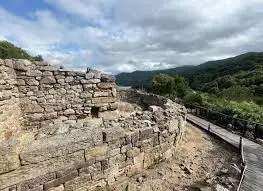
The greatest thinker wasn't Halkidiki's only gift to the world — the peninsula is also a field of mythology: here the gods buried the Giants beneath the three "fingers", and Athos itself is said to be a hurled boulder.
The Giants and the Gigantomachy
The broader area of Halkidiki was considered in antiquity the site of the Gigantomachy, the epic battle between the Olympian gods and the Giants. The Giants, children of Gaia, lived in Phlegra — a name that originally referred to all of Halkidiki, but later became specifically associated with Kassandra. The battle broke out when the Giants, armed with stones and fiery torches, attempted to overthrow the Olympians.
According to the myths, the Giants were defeated with the help of Heracles — one legend states that Fate herself had written that the Giants would be defeated only if a mortal assisted the gods. The bodies of the defeated Giants were buried beneath the mountains of the area, and the volcanic activity of Halkidiki (which no longer exists but was present in prehistoric times) was attributed to their breaths.
Specific Giants were associated with specific locations: Enceladus with Sicily (where he was buried under Mount Etna), Porphyrion with Kos, and Athos with the peninsula of the same name.
Athos and the Naming of the Mountain
The most well-known myth related to Halkidiki: Athos was one of the Giants who hurled a massive rock at Zeus during the Gigantomachy. The rock fell into the sea and created the peninsula and the mountain that today bear his name. Another version states that Zeus himself pushed the Giant Athos into the sea, and the pile of rocks he created formed the mountain.
Whichever version, the result is that Mount Athos at 2,033 meters is "giantism" in natural formation — a pointed stone peak that rises steeply from the sea, unique in the geomorphology of the Mediterranean.
Sithonia — the Daughter of Poseidon
Sithonia, the second peninsula, is named after Sithon, the mythical king of the area and son of Poseidon and Chione (daughter of Boreas). According to Diodorus, Sithon was the father of Pallini, who also gave her name to Kassandra (the ancient name was Pallini).
Sithon was known for his violent nature — he fought with the suitors of his daughter and made the duel with him a condition for marriage. Many young men died in the process. In the end, Pallini fell in love with Cleitus, and with the help of Zeus, she survived the duel against her father.
Kassandra / Pallini — From Mythology to Byzantine Naming
The first peninsula has a double name: the ancient was Pallini (after Sithon's daughter), the modern is Kassandra from the general of Alexander the Great who founded the city Kassandreia in 316 BC on the site of the destroyed Potidaea. The name "Kassandra" survives in the modern toponym of the peninsula, while "Pallini" has remained as a less commonly used ancient name.
In the same Pallini/Kassandra is also linked the myth of Potidaea, which took its name from Poseidon's son Potidas.
Dionysus and Stagira
Dionysus, the god of wine and fermentation, was closely associated with Halkidiki. According to some traditions, one of Dionysus's journeys brought him to the peninsula, where he introduced viticulture. It is no coincidence that even today Sithonia and Kassandra produce notable wines — the tradition has ancient roots.
In Stagira, the birthplace of Aristotle, there was a temple of Dionysus, and the philosopher mentions Dionysian rituals in various works of his.
Nymphs of Pallini
The ancient Greeks believed that every natural site (spring, forest, mountain, sea) was inhabited by a nymph — a female spiritual entity connected to the place. Pallini was rich in such traditions. The Nymphs of the Nymphaeum, nymphs of the springs, are mentioned in shrines near modern Kallithea and Afytos. In the modern archaeological site of the Kallithea Thermal Baths, there is a small temple dedicated to such deities.
Petraloona — the "First" Halkidikian (700,000 years)
Beyond the classical myths, Halkidiki has been linked to human prehistory in a way that transcends mythology. In the Petraloona Cave (near Nea Moudania), the skull of the "Petraloona Man" was discovered in 1960 — one of the oldest human evidence in Europe, approximately 700,000 years old (some researchers argue 250,000-500,000). This archaeological discovery has made Halkidiki significant for the study of human evolution.
The cave is visited with a guided tour. A museum is also in operation. Entrance is 8 euros for adults, 4 euros for children.
Where You Can See Mythology in Modern Halkidiki
- Petraloona Cave: Paleolithic center
- Ancient Stagira (Olympiada): the birthplace of Aristotle, with an ancient agora and Aristotle's Grove
- Kallithea Thermal Baths: ancient sanctuary of Nymphs
- Ancient Olynthos: an important city of the 5th century BC destroyed by Philip II. Today an archaeological site with houses in excellent condition (mosaics).
- Ancient Potidaea: remains of a wall and ancient harbor near the canal
- Polygyros Archaeological Museum: collection of findings from all over Halkidiki, with elements of Dionysian worship
- Ancient Sani: few ruins but historically significant city
- Ancient Mendi (near Kalandra): a commercial city known for Mendaean wine — one of the most famous in ancient Greece
How to Combine Mythology with Vacation
A "mythological Halkidiki" itinerary could include:
- One day in Olynthos + Potidaea (ancient city of Pella, together 4-5 hours)
- One day at the Petraloona Cave + Polygyros Archaeological Museum
- One day in Stagira + Aristotle's Grove (Olympiada)
- One day on a Mount Athos cruise (mystical tradition, although of Christian era, complements the "spiritual geography" of Halkidiki)
Ancient mythology is silent but ever-present in the place names and monuments of Halkidiki. For those interested in more than just beaches, the area offers two additional layers of depth: the prehistoric and the mythological-ancient.
Practical notes for international visitors
For mythology fans (hello, school-days memory) Halkidiki is a treasure chest: here the gods buried the Giants under the peninsulas, and Athos itself is said to be a hurled boulder. The appeal on the ground is that the settings are now beaches and mountains you actually visit — myth you can stand on, not display-case history.