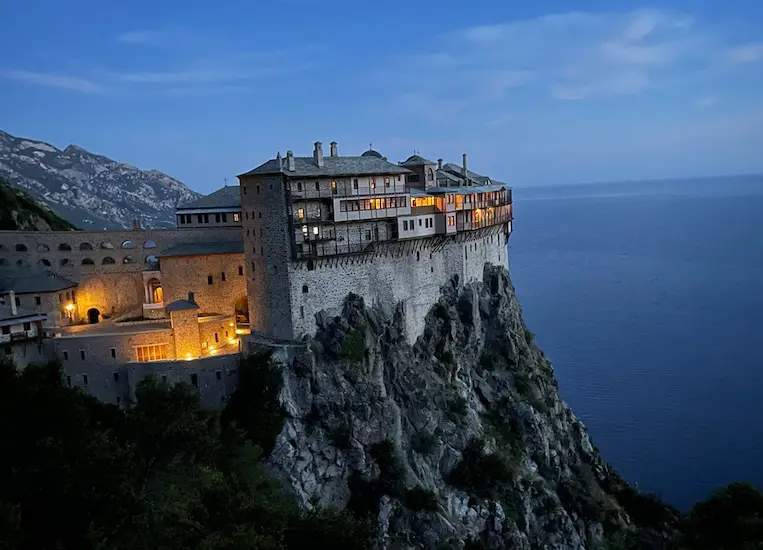
For most visitors, Athos stays a view from the boat — and that's grand enough: the cruises along the peninsula pass the monastery front at the legal minimum distance, women and families included. For the land visit, the road runs through the Pilgrims' Bureau.
For Men: Visiting with a Permit
Entry to the Athos peninsula is allowed only for men with a special permit — the permit. It is not a visa and it is not free.
How to Obtain It: You contact the Pilgrims' Office of Mount Athos in Thessaloniki (phone and email via the official website of the Holy Administration). You must apply at least 1-3 months in advance — the spots are limited to 100 Orthodox and 10 non-Orthodox per day. You send your passport details and preferred date. Once approved, you receive a beep for collection at the office upon arrival.
Cost: 30 euros for Orthodox, 35 euros for non-Orthodox. You pay at the office when you collect the permit.
Duration: Initially 4 days/3 nights. Extensions can be requested in Karyes.
Age Limit: Men 18+. Children and teenagers under 18 are allowed only with a father/relative's accompaniment and special permission.
How to Get There
The only legal entry is by sea, via ferry from Uranoupoli (main route) or from Jerissos (for the eastern coast). The ferry from Uranoupoli departs at 9:45 AM. The journey takes 1 hour and 50 minutes to Dafni, which is the official port of Mount Athos. The ticket costs around 8-10 euros.
From Dafni, there are buses to Karyes (the administrative center) and small boats to the more remote monasteries. Transportation is only possible by vehicle on certain dirt roads or by hiking — do not expect tourist infrastructure.
Accommodation in the Monasteries
Each monastery accepts pilgrims free of charge (hospitality), but you must notify in advance by phone — no spontaneous appearances. You will be provided with a bed in a dormitory (usually shared), and meals from the monastery. Tipping at the iconostasis/secretariat is customary but not mandatory.
You must respect the monastery's schedule: wake-up before sunrise, Orthros and Divine Liturgy from 04:00-08:00, meal (lunch) at 09:30 and 16:00, Vespers at 17:00. You cannot stay isolated in your room all day.
How to Dress and Behave
Long pants, long-sleeved shirt/blouse, covered shoulders. No shorts or sleeveless tops even in summer. No hats in churches. Photography is allowed in outdoor areas but prohibited inside churches and during services. You are not allowed to photograph monks without permission.
There is no Wi-Fi in most monasteries, mobile phone signal is limited, and the pace of life is slow. This is part of the experience.
For Women and Children: The Ban
Women have been prohibited from entering since 1045 (the chrysobull of Constantine IX Monomachos). The ban is officially upheld by Greek law and has been confirmed in the Accession Treaty to the EU. The entry of female animals is also prohibited (exception: cats and chickens, for practical reasons).
What can be done: pilgrimage cruise. Boats from Uranoupoli operate a route along the western coast, maintaining a distance of at least 500 meters from the shore (as stipulated by law). You can see the monasteries from the sea, with a close enough view to distinguish the architecture. Duration is around 3-4 hours, cost 25-35 euros per person.
From Jerissos, there is a similar cruise along the eastern coast. Usually less traffic, you pass in front of Staurovouni, Pantocrator, Karakallou, and Great Lavra.
The 20 Monasteries in Brief
In order of the Holy Administration:
- Great Lavra — first founded (963 AD), southeastern tip
- Vatopedi — second in line, one of the wealthiest
- Iveron — known for the Virgin Portaitissa
- Chilandariou — Serbian
- Dionysiou — impressive location on a cliff
- Koutloumousiou — near Karyes
- Pantocrator
- Xeropotamou
- Zografou — Bulgarian
- Dochiariou
- Karakallou
- Philotheou
- Simonopetra — also dramatically located on a cliff
- St. Paul's
- Stavronikita — the smallest
- Xenophontos
- Grigoriou
- Esphigmenou
- St. Panteleimon — Russian
- Konstamonitou
In addition to the 20 main monasteries, there are 12 sketes, hundreds of cells, and hermitages (hermits living alone in remote areas, some in caves).
A Bit of History Explaining the Present
The monastic presence on Athos dates back to the 4th century (individual hermits), but organized monasticism was established with the founding of the Great Lavra by St. Athanasius the Athonite in 963 AD, funded by the Byzantine Emperor Nicephorus Phocas. Since then, there has been continuous monastic life — over 1,060 years uninterrupted. It survived Ottoman rule (1430-1912) with a special tax status and maintained its autonomy in modern Greece.
It has been a UNESCO World Heritage Site since 1988. Its library contains 13,000 manuscripts and 100,000 old printed books — one of the most important collections of Byzantine literature in the world.
Best Time to Visit
Male pilgrims: May or September. Avoid the heat of August (which is severe — most monasteries do not have air conditioning) and the winter rains. During the winter months (November-February), many roads become impassable.
Cruises for women/mixed groups: June-September. Calm sea, good visibility.
Practical Tips
- Bring cash. There are no ATMs within the peninsula, and the monasteries do not accept cards.
- Good hiking shoes are essential. Many routes between monasteries are only accessible on foot.
- Bring your own shampoo, soap, towel — the monasteries provide the basics but don’t rely on it.
- Do not attempt to enter without a permit. There are checks at Dafni and Karyes, and the penalty is arrest and deportation.
- Respect the rules of silence during services. The monks are not a tourist attraction.
Practical notes for international visitors
For most international visitors Athos stays a view from the boat — and that's grand enough: the cruises from Ormos Panagias or Ouranoupoli pass the monastery front at the legal minimum distance, women and families included. The land visit (men only, max 10 non-Orthodox per day) runs through the Pilgrims' Bureau, months ahead. Respect basics that matter on site: no drones, no telephoto on monks — and that very untouchability is what makes the place extraordinary.