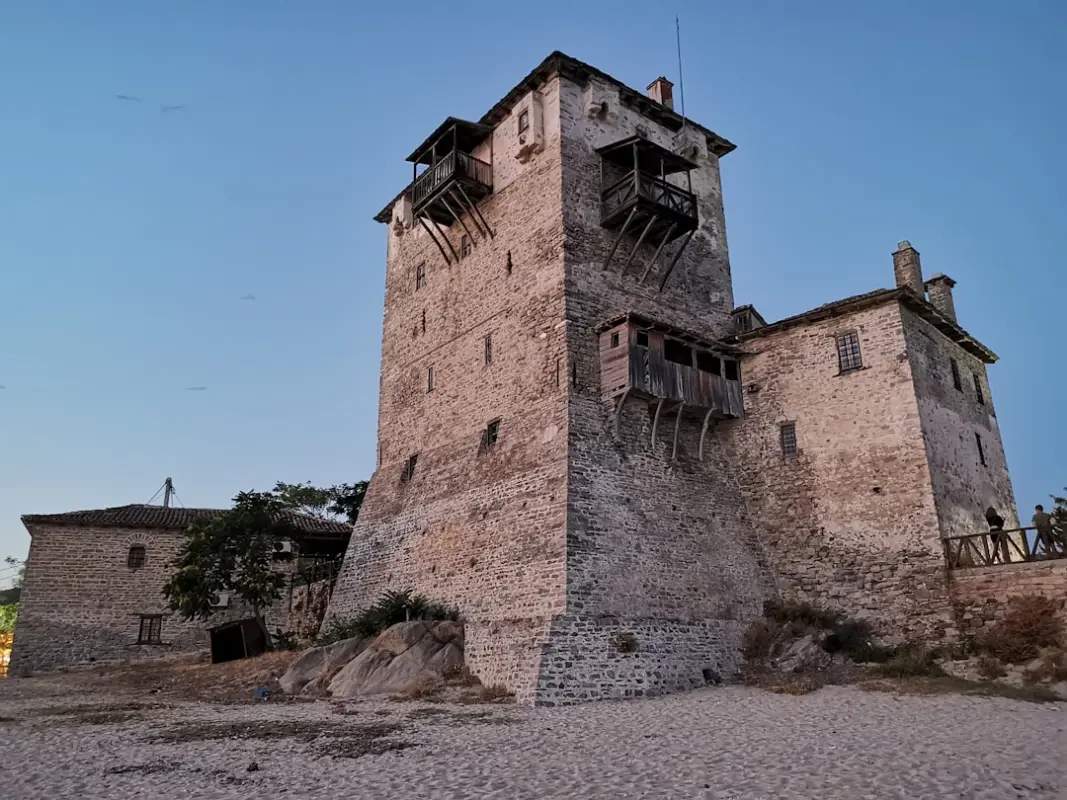
Sarti has something few places on Sithonia manage: three kilometres of sand, Mount Athos on the horizon, and a centre that genuinely comes alive in the evening — without tipping into party excess. The last half-hour of the drive, along the panoramic east coast, already tells you you've arrived somewhere special.
If this is your first time considering it for a vacation, the guide below covers the essentials: how to get there, which beaches are worth a detour, where to eat without being overcharged, and when the right time to go is.
How to Get There
From Thessaloniki, you have two options. The shortest route is via Polygyros and Ormylia — about 130 kilometers and a 2-hour drive without traffic. The alternative, through Nikiti and the western coast of Sithonia, is more scenic but adds 30-40 minutes: you pass through Neos Marmaras, Toroni, and Sykia before arriving. If it's your first time, my recommendation is to go one way and return the other.
With KTEL from the Halkidiki station in Thessaloniki, there are 2-3 departures daily during the summer months, taking about 3 hours and 30 minutes. The ticket costs around 18-22 euros. The downside: within the village, there aren't many transportation options without a car, so if you want to visit nearby beaches, you'll need to rent one either in Thessaloniki or on-site (there are a few rental offices in the village, but they are likely more expensive and offer less choice).
Airport: Macedonia (SKG) is about 145 kilometers away and an additional hour and a half from Thessaloniki. A taxi costs around 160-180 euros for the trip, while a van transfer for 4-6 people is about 200-230 euros.
The Beach of Sarti and What Makes It Unique
The main beach starts right from the small harbor and stretches southward. It is sandy, with a shallow bottom for at least 30-40 meters — which is why it is favored by families with children. One section (near the village) is fully organized with sunbeds, beach bars, and showers. As you head further south, the organization thins out and transitions into a free section, ideal if you want your own towel and some peace.
What sets it apart is the view. Looking west, you see Mount Athos rising 2,033 meters above the sea. At sunset — especially in July and August — the sun sets behind the mountain, casting its shadow over Sarti. It is one of the few beaches in Greece that offers this unique perspective.
Nearby Beaches You Must See
Sarti is a great base because in less than a 30-minute drive, you have access to some of the most famous beaches in Sithonia:
- Kavourotripes (Orange): 12 kilometers southwest, via dirt road for the last two kilometers. White rocks, small coves, no sunbeds. Bring water with you — there are no kiosks.
- Karydi: 24 kilometers north, towards Vourvourou. Possibly the most photographed beach in Halkidiki. Shallow turquoise waters over white sand. There is paid parking and a beach bar.
- Lagoonisi: 7 kilometers south, on the northern side of the cape of the same name. Quiet, partially organized, ideal for the hottest hours of the day.
- Armenistis & Platanitsi: 6 kilometers north. Two neighboring beaches, the first with camping and a pine forest down to the sea.
If you have time for a whole day, the boat trip to Diaporos island and the smaller islands around it (Agios Isidoros, Prasonisi, Ambelos) departs from the small harbor of Sarti. The cost is around 35-45 euros per person, including a meal. It typically departs at 10:00 and returns between 17:00-17:30.
Food
Sarti doesn't have a gourmet scene. It has a few good tavernas with seafood, café-bars along the waterfront, and some beach bars. Prices are standard for tourist Halkidiki: a paid portion at a taverna costs around 12-18 euros, a carafe of ouzo 5-7 euros, coffee 3-4 euros.
- Fruit Decor — one of the most reliable traditional choices, with homemade dishes and affordable prices.
- Melia — more "fine" cuisine, Mediterranean with an emphasis on seafood. A good choice for a somewhat more formal evening.
- Maroon — café and cocktail bar, a good choice for brunch or an afternoon drink.
- Yucca Beach Bar — right on the beach, good atmosphere at sunset.
If you want fish straight from the boat, ask the fishermen at the harbor in the morning — usually between 7:00-9:00 they catch red mullet, bream, and small fish. Several tavernas source their fish from there.
Accommodation
Most accommodation options in Sarti are rented studios and apartments, mainly family-run businesses. There aren't many large hotels — those are mostly in Neos Marmaras. Indicatively:
- Studio for 2 people: 50-80 euros/night in June and September, 90-130 in July-August.
- Apartment for 4 people: 90-140 euros/night in low/mid-season, 150-220 in August.
- Villa for 6 people: from 180 euros/night in June to 350-450 in August, depending on the distance from the sea and whether it has a pool.
Practical note: July and August fill up quickly. If you're aiming for those months, make reservations 3-4 months in advance. For June or September, a month ahead is sufficient.
When is the Best Time
September is undoubtedly the best month for Sarti. The sea reaches 24-26°C, the air is milder (24-29°C), and the village empties out by mid-month — many hoteliers drop prices by 20-30%. June is the second good option for those wanting to avoid crowds.
July-August is peak season: lively atmosphere, crowded tavernas, and many Greek families on their two-week vacations. If this suits you, you know what to expect. If not, stay away from the last two weeks of August.
From November to April, Sarti is almost completely closed. A few cafés and tavernas operate for locals, but most visitor infrastructure is shut down.
A Bit of History Worth Knowing
The "old" Sarti was located two kilometers inland, at the foot of Mount Itamos. It was completely destroyed by the earthquake of 1932 and the subsequent landslides, and the village was relocated to its current seaside position. The ruins of the old Sarti are still visible and can be visited — there is signage from the road to Sykia. It's a short walk (about 20 minutes) and offers a good panoramic view of the bay.
The name comes from the ancient city of Sarti, mentioned by Herodotus. In antiquity, it was a member of the Athenian League in the 5th century BC.
Practical Information
- In the village, there are 2 ATMs (Piraeus, Eurobank), a pharmacy, a supermarket, and a gas station.
- 4G/5G coverage is good throughout the village; weaker at the more remote beaches.
- If you have a boat or SUP, there is a small protected marina at the harbor.
- A beach umbrella for one day costs 8-15 euros depending on the location and season.
- Parking in the village is free but fills up — after 11:00 you may need to leave your car 200-300 meters from the beach.
Practical notes for international visitors
Sarti is the liveliest spot on east Sithonia — popular for the mix of a three-kilometre sandy beach, Mount Athos on the horizon, and a village centre that actually has an evening buzz without the party excess. Roughly 2 hours from SKG airport, with the final half-hour along the panoramic east coast being the prettiest.
Accommodation tip: rooms "one street back from the beach" cost noticeably less and are still a two-minute walk from the water. From here, Kavourotripes (15 min) and the Athos boat trips are the must-dos.