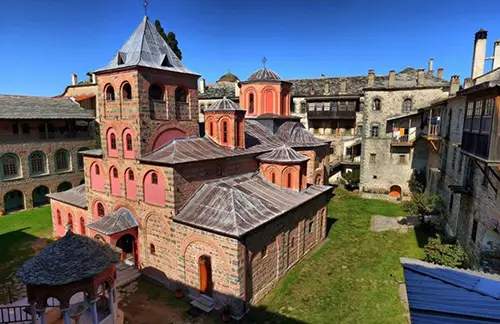
Halkidiki has an exceptionally rich Orthodox monastic tradition. Beyond the famous Mount Athos (which is a closed state of 20 monasteries), there are notable monasteries throughout the region — many of which are accessible and active today. This is an important and often underrated aspect of Halkidiki, with a history of over 1,000 years and remarkable works of art.
Mount Athos — Monastic State
Mount Athos (the third leg of Halkidiki) is an autonomous monastic state with 20 active monasteries and around 2,000 monks. Continuous monastic presence since the 9th century. UNESCO World Heritage Site since 1988.
Visit:
- Men with accommodation permit (approval from the Pilgrims' Office in Thessaloniki): 30-35 euros, application 1-3 months in advance
- Women: only cruise from Ouranoupoli or Ierissos, 25-35 euros, duration 3-5 hours
See our dedicated guide to Mount Athos for more information.
Monasteries Outside Athos — Accessible to All
1. Monastery of Saint Anastasia Pharmakolytria (Vasilika)
Located in central Halkidiki, 8 km from Galatista. One of the most important women's monasteries in Northern Greece. Founded in the 14th century and has a continuous presence. It hosts around 50 nuns and is an important pilgrimage center for Saint Anastasia Pharmakolytria — the patron saint of those suffering from psychological issues and addictions.
- Open to visitors daily (hours vary)
- Free admission
- Cathedral with notable frescoes
- Accommodation for pilgrims
- Tradition of producing Athonite tsipouro and other products
2. Monastery of Ormylia (Holy Trinity)
In Ormylia, central Halkidiki. A women's monastery with modern organization — founded in 1974 as a dependency of the Athonite monastery of Simonopetra. Today it has over 100 nuns, making it one of the largest women's monasteries in Europe.
- Open to visitors
- Tradition of producing icons, psalter
- Numerous coastal buildings
- Good accommodation for pilgrims
3. Monastery of Archangel (near Polygyros)
A small men's monastery in a mountainous location. Less known, but noteworthy.
4. Monastery of the Virgin Mary Faneromeni (Pefkochori)
At an altitude above Pefkochori. A modern monastery with a beautiful location.
5. Dependencies of Mount Athos Outside the Peninsula
Many monasteries of Mount Athos have dependencies (estates and buildings) in various parts of Halkidiki — Nea Fokea, Kalandra, Sarti. Some are accessible.
Behavior in a Monastery
In all Greek Orthodox monasteries, there are rules regarding dress and behavior:
- Women: long skirt (covering knees and below), long sleeves or a tunic covering the shoulders. No trousers. It’s better to cover your head inside the cathedral.
- Men: long trousers, long-sleeved shirt. No shorts, sleeveless shirts. No hats inside the churches.
- Photography: usually allowed outdoors, generally not inside the cathedrals. Always ask first.
- Silence: during services and in the cells. Do not make noise.
- Tip: customary but not obligatory. At the iconostasis or at the reception.
Best Time to Visit
The monasteries are open to visitors year-round, but:
- May-June and September-October: milder weather, fewer pilgrims
- Summer: hot, more crowded
- Major holidays (Easter, Assumption): full liturgical presence, but crowded
How to Combine in an Itinerary
A "spiritual Halkidiki" trip of 2-3 days:
- Day 1: Monastery of Ormylia + Monastery of Saint Anastasia
- Day 2: Mount Athos cruise from Ouranoupoli
- Day 3 (for men with accommodation permit): visit 2-3 monasteries within Athos
Who Will Find This Interesting
- Orthodox pilgrims
- Fans of Byzantine art and architecture
- Those interested in history and culture
- Visitors seeking a "different" experience beyond the beaches
- Monument photographers
Practical notes for international visitors
The monasteries outside Athos are the accessible alternative for everyone — women and families included: living Orthodox spirituality without permit bureaucracy. Rewarding even for the secular visitor as architecture, history and stillness. The dress code is taken seriously (long trousers or skirts, covered shoulders — wraps often at the door); ask before photographing interiors, and plan around midday closing.