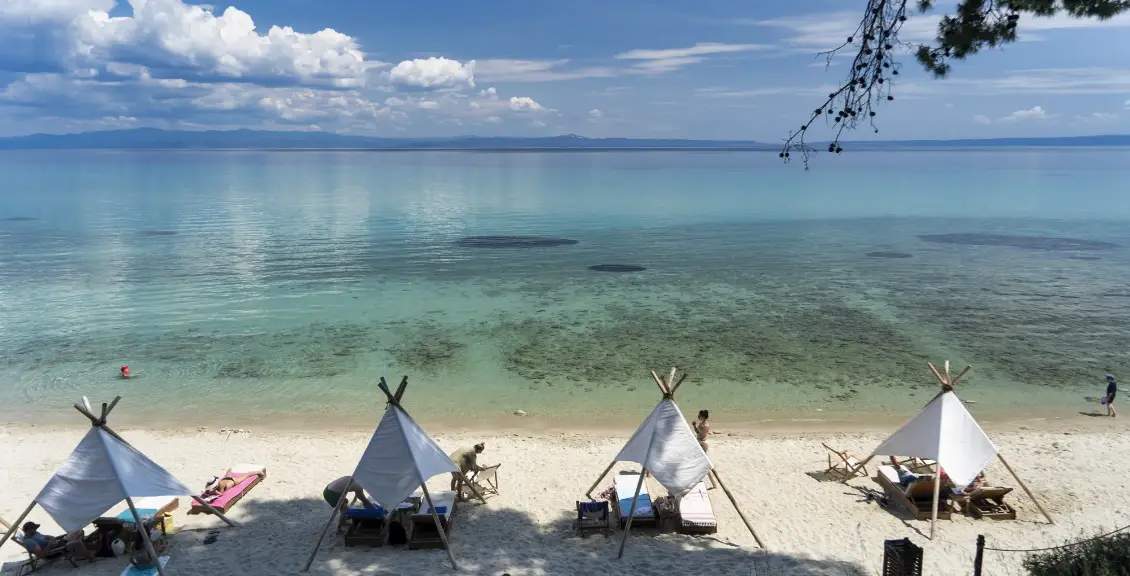
There's a moment, usually in mid-August, when you look at the sunbeds packed rail to rail and wonder where the Greece from the photos went. Good news: it's a few kilometres away. Beyond the famous names, Halkidiki hides dozens of coves where even at peak season you can find a corner of your own — if you know where to look and what to bring. This guide takes you straight there.
Why some beaches stay quiet
Three things keep a beach empty even at peak season:
- Difficult access: A dirt road, a walk or a stairway discourages most people
- No facilities: Without sunbeds and a beach bar, only the self-sufficient remain
- Distance from the hubs: The further from Hanioti, Kallithea and Nikiti, the fewer the people
The rule cuts both ways: quiet beaches demand preparation. Water, shade and supplies are your responsibility.
Sithonia: the kingdom of quiet
Spathies: On west Sithonia between Nikiti and Neos Marmaras, next to Elia — reached via a side road off the main route. White sand, crystal-clear water, minimal facilities — one of the area's most untouched beaches.
Tourkolimnionas: A hidden cove on eastern Sithonia, reached by dirt road. Excellent snorkeling — few people know it.
Diaporti: Between Neos Marmaras and Toroni, next to Azapiko, with the shallow passage to Pounta islet — at low water you can almost walk across. No infrastructure at all, quiet even in August.
Mikro Kastri: 300 metres from the organized Kastri beach of Nikiti, yet a world apart — free, pine-shaded, nearly empty. Anything you miss is a 5-minute walk away.
Agios Ioannis: West Sithonia, next to Kastri, with a chapel and a quieter feel.
Tristinika: A long sweep of sand in southwest Sithonia — better known these days, but its sheer size absorbs the crowds and the far ends stay quiet.
Latoura, Griavas, Fava, Koviou: Small local coves known mostly to residents — more than ten umbrellas counts as a bad day.
Kassandra: quiet corners on the busiest peninsula
Kassandra is the most touristic leg, but it has its exceptions:
Kavouri: A small bay in southwestern Kassandra with a rich seabed for snorkeling. Almost always quiet.
Varkes: The cove below the bluffs of Afytos. It fills with village visitors at midday, but early in the morning it is almost yours — and the walk down the steps keeps most people away.
Myti, Moudounou, Liosi: Local beaches of eastern Kassandra, away from the Kallithea-Hanioti axis — mostly used by people with summer houses next door.
Elani: A free stretch of sand between Siviri and Possidi, no facilities.
Possidi (the far ends): The cape has extensive sands — walk 500 metres from the centre and you have room for a party… of silence.
The Athos side and the islands: Halkidiki at its most untouched
Komitsa: Near Ouranoupoli, pine-backed with views of Mount Athos — free, with parking, rarely full.
Develiki: Pebbles, clear water and a setting that feels more like "hidden Greece" than a resort. Bring everything — there is nothing there.
Kakoudia: Between Ierissos and Nea Roda, an open stretch of sand with no infrastructure — space by the square kilometre.
Drenia: The uninhabited islets opposite Ammouliani — reachable only by boat, an almost private-island experience.
Agios Georgios (Ammouliani): On the island's eastern side, far quieter than Alykes, with views towards Mount Athos.
The quiet strategy — even at the famous ones
You don't always need a dirt road. Even Karydi or Sarti are peaceful if you:
- Go 8:00-10:30 in the morning or after 17:00 — the crowds arrive 11:00-16:00
- Choose June or September — same sea, half the people
- Avoid July-August weekends, when Thessaloniki's day-trippers join in
What to bring
- 2L of water per person and snacks — most of these beaches have no canteen at all
- Umbrella or UV tent — shade is usually non-existent
- Water shoes — rocks and sea urchins at the edges of many coves
- A rubbish bag — there are no bins; whatever you bring, you take back
- A full tank — petrol stations thin out towards the southern tips
- Cash — where a canteen does appear, a card terminal is a luxury
Practical notes for international visitors
The rule for finding empty sand is simple: the further from the charter heartland of Kassandra, the quieter it gets. Sithonia and the Athos coast reward the longer drive (1.5-2 hours from SKG airport) with coves that barely exist elsewhere in the Mediterranean anymore.
A hire car is essential here, not a luxury — many of the best spots sit at the end of dirt tracks that a normal car handles fine at walking pace. Take full insurance with zero excess to skip any argument over gravel scratches, carry cash and 2 litres of water per person, and take everything home with you: none of these beaches has a bin.
Frequently asked questions
Which is the quietest beach in Halkidiki in August?
Among the named ones, Diaporti and Spathies in Sithonia stay remarkably empty even at peak — the lack of facilities acts as a natural filter. On the Athos side, Kakoudia always has space.
Are there quiet beaches with easy access?
Yes: Mikro Kastri (300 m from asphalt and an organized beach), Komitsa (with parking) and the far ends of Possidi require neither dirt roads nor hiking.
Are secluded beaches safe for swimming?
Generally yes — Halkidiki's bays rarely have currents. But no lifeguard means conservative swimming: stay within standing depth, especially with children.
Want the opposite — facilities, shallow water, family infrastructure? See the shallow-water beaches and the family guide.