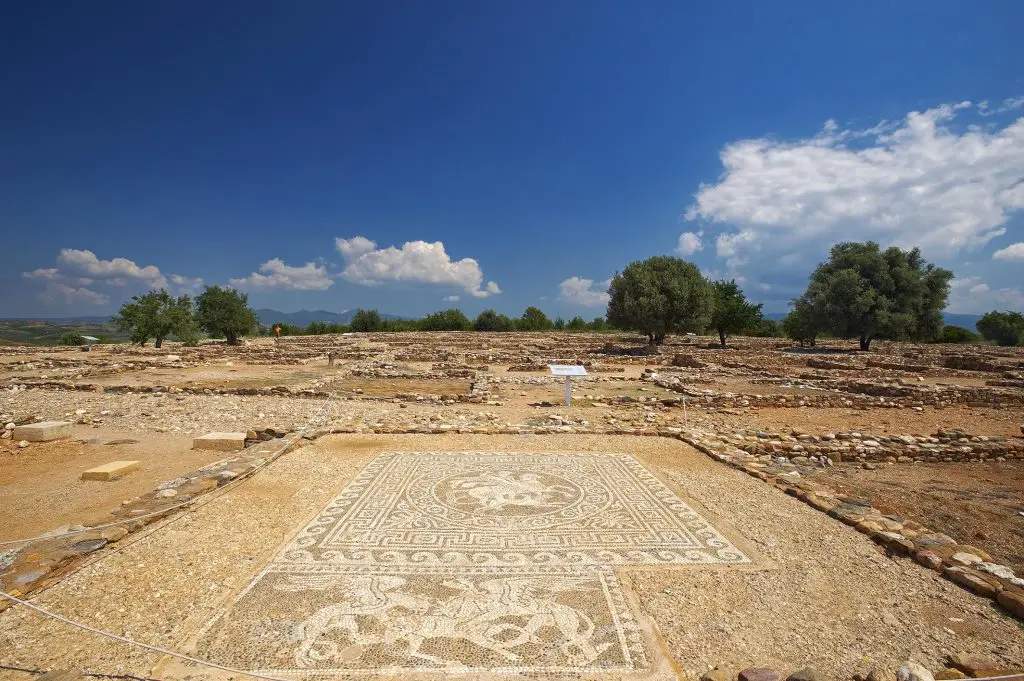
Olynthos is the village beside one of Greece's most important ancient cities — and perhaps Halkidiki's most underrated archaeological date: ancient Olynthos, with the first complete Hippodamian grid plan and its famous mosaics, occupies the two hills just outside today's settlement (~500 residents), among olives and vines.
Ancient Olynthos
The city Philip II destroyed in 348 BC is today an open lesson in ancient urban planning: a street grid, building blocks, houses with inner courtyards — and pebble mosaic floors that are among the oldest in Greek art. The site has shade, a path and a small museum pavilion; allow 1.5-2 hours.
Around the village
- Wine tasting (1.4 km): The local estate is one of Halkidiki's best-known producers — an ideal pairing with the archaeological site.
- The sea: Agios Mamas (4.7 km) for a quick swim, organized Nea Moudania (8.1 km) for full facilities.
- Moudania (8 km): The Folklore Museum and the Fishing Vessels Museum for the maritime side of the story.
Food and stay
Tavernas and kafeneia in the village — simple, honest, agricultural. Accommodation is limited (rooms and agrotourism units); most people visit Olynthos as a day trip from Moudania or Gerakini. Browse stays in the area.
Practical
- Distance: ~70 km from Thessaloniki (1h) — an easy stop en route to Kassandra or Sithonia.
- The site: Limited opening hours (mainly mornings in summer) — go early, with water and a hat.
- Best period: Spring and autumn for the site, summer for combining it with a swim.
Practical notes for international visitors
Ancient town planning straight from the textbook — literally: Olynthos is THE case study of the Hippodamian grid, and visitors with a history bent walk through the original set. Come in the morning (shade!), bring water, then the winery next door — learning was rarely this relaxed. Signage Greek/English; the site keeps limited summer hours, so check first.
Frequently asked questions
Is ancient Olynthos worth it if I've seen Vergina/Dion?
Yes — it is a different genre: not tombs and temples, but an entire city in plan view, where you grasp how a classical Greek city actually lived. And you almost always have it to yourself.
How far is the sea?
Agios Mamas is 5 minutes, Nea Moudania 10 — Olynthos combines easily with a swim on the same day.
More: the Olynthos page and the feature on ancient Halkidiki.